The most important moment in a Physical AI deployment is the moment the work can continue without you.
Physical AI is bringing a growing range of robot capabilities into view. Demonstrations show robots learning to handle objects, manipulate unfamiliar materials and perform tasks that once seemed out of reach. The next challenge is turning those capabilities into useful work on a customer’s floor.
At Gobano, that is our focus: deployment that delivers autonomous work. That means the robot performs its task repeatedly without someone directing each action or supervising every cycle. In a laundry, towels shift, grasps miss and conditions vary. The station must handle the errors it can resolve, recover and continue—so an employee can get on with another job instead of staying at the controls.
Here, we share our experience from this laundry deployment and the milestone we have reached: hours of autonomous work alongside the customer’s team. We look at what it takes to keep the station running, the performance it delivers today and how we are building on that progress.
A new coworker on the laundry floor
From day one, the station contributes to production, freeing employees to focus on other tasks. It takes on repetitive towel handling alongside the existing laundry team.
Its autonomy covers that task. Employees keep materials moving, replenish the station and manage maintenance and the surrounding operation. They also handle exceptions the robot cannot resolve. What changes is that they no longer need to direct each movement or supervise every cycle.
For a customer, the benefit is practical: repetitive work can continue while the team attends to the rest of the laundry. The station has to earn its place through useful output and a clear division of responsibilities.
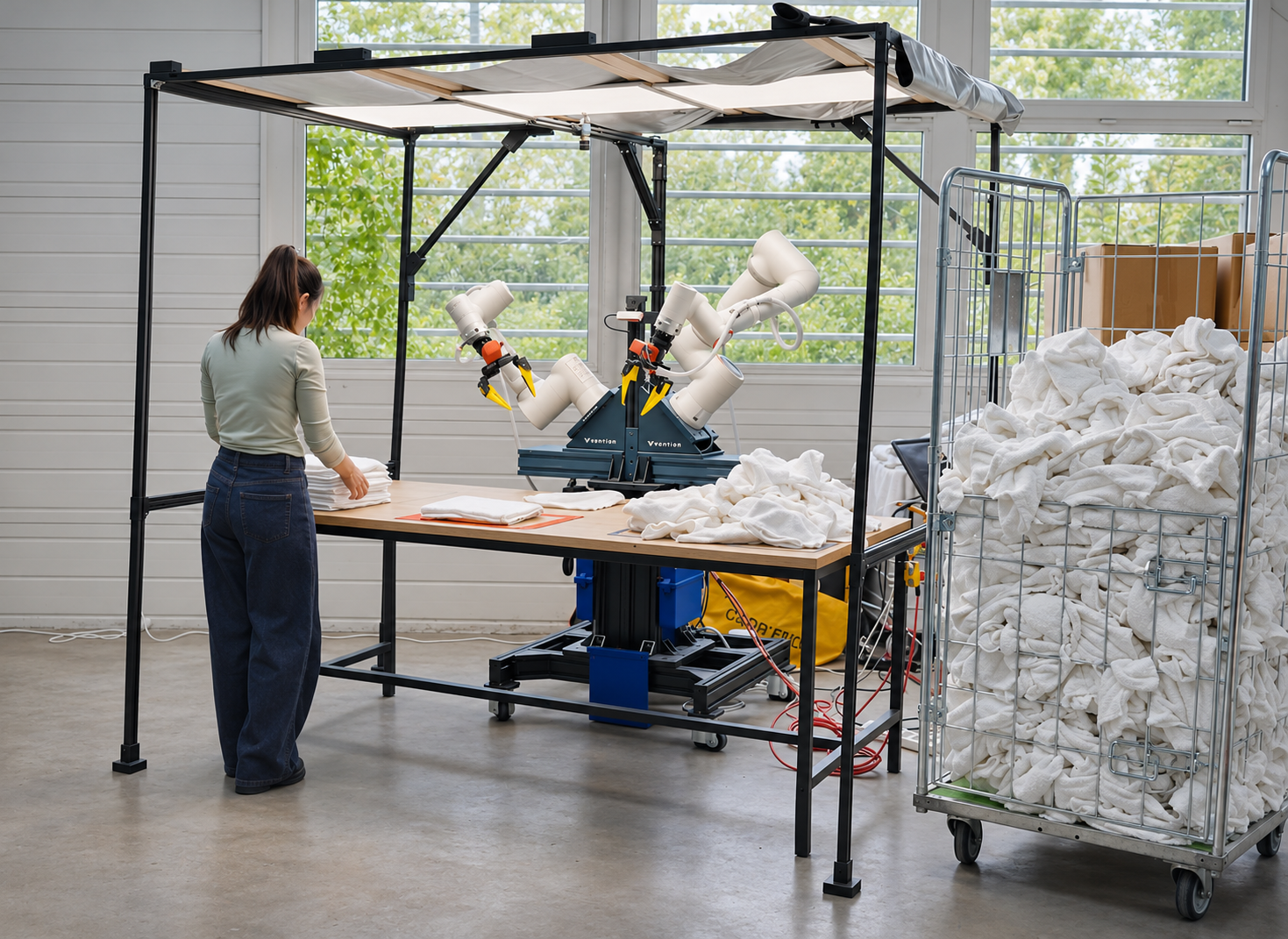
Reliability means keeping the work moving
Handling a garment or towel with a robotic gripper can lead to mishaps because fabric bends, folds and slips as the robot moves it. A grasp can miss or catch several layers, and an item can land in an unexpected position. A movement that worked on the previous cycle may need another attempt on the next one. Handling these variations is part of the job.
Autonomous recovery lets the station respond to setbacks and resume the task. An unsuccessful attempt that the robot resolves itself has a different consequence from a stoppage that pulls an employee away from other work. That is why task success and autonomy need to be measured separately.
The meaningful unit of progress is the work completed between human interventions.
Recovery still costs time. The operational goal is to complete more useful work between interventions, with fewer retries and less time spent recovering. Throughput must include that recovery time to reflect what the station actually delivers.
Behind the scenes: learning to fail less with Reinforcement Learning
A towel changes shape as it is grasped and moved. Its position, folds and contact with the gripper affect what happens next. The controller must respond throughout the task rather than replay a fixed sequence of movements.
When we introduced Toutatis, our Reinforcement Learning engine, we described how we approach this problem. Human demonstrations establish an initial capability. A task-specific world model represents the scene and its dynamics. Reinforcement Learning then uses robot experience to improve the policy against the task’s operating objectives.
The priority is to reach the required reliability, then increase throughput while preserving it. A faster movement is valuable when it produces more completed work without increasing the need for human intervention.
The learned policy is one part of the system. It must work with sensing, grippers, task sequencing and recovery. Bringing those components together is what turns a learned skill into a station that can keep working on a customer’s floor.
Every shift gives us more to improve.
Once the station can work autonomously, the next challenge is to increase the useful output it delivers. Production shows us where time is lost: repeated attempts, slow movements and recoveries that take longer than they need to.
Demonstrations show how a person performs the task. Autonomous operation adds experience of the robot’s own behaviour, including the failures and unusual situations that limit its performance. Those observations help us choose what to train on next.
Useful autonomous work
Successes, recoveries, cycle times
Evaluate against reliability and throughput targets
We feed that experience into Toutatis through a focused cycle: identify the bottleneck, train an improved policy, evaluate it and redeploy. The comparison must account for completed work, recovery time and human interventions. A speed gain that creates more stoppages is not an operational improvement.
This is the value of the production data flywheel: experience is tied to a specific failure or delay, then used to target a measurable improvement. As the station completes more cycles, it creates further opportunities to learn. Each update has to earn its place through better performance on the floor.
One workflow today. More capable workers next.
An autonomous worker is now taking on a repetitive task in a real laundry, alongside the people who keep it running. This is what a successful Physical AI deployment looks like in 2026. The lessons learned on the floor are invaluable: they reveal what makes autonomy useful in practice and what it takes to sustain it.
For us at Gobano, this is not the end, but rather a first step. Our next objectives are concrete: longer autonomous runs, greater useful output and the ability to handle a wider range of materials and workflows.
We want each new robot to benefit from the failures, recoveries and successful behaviours already encountered. Making that learning reusable across deployments is how we bring more intelligent and capable robots onto industrial floors.
We stepped away. Our autonomous worker kept going.
Now, we are building what it can take on next.